Five minutes a day, done consistently, will teach your child more than an hour-long session once a week. This is not motivational advice. It's how memory actually works.
Why Frequency Beats Duration
Hermann Ebbinghaus mapped the forgetting curve in 1885, and nothing since has disproved it. Without reinforcement, we forget roughly 50% of new information within an hour, 70% within a day, and close to 90% within a week.
The antidote is not studying harder. It's studying more often.
Spaced repetition — reviewing information at increasing intervals — is the most evidence-backed learning technique in cognitive psychology. A 2006 meta-analysis in Psychological Bulletin (Cepeda et al.) reviewed 254 studies and found that spaced practice improved long-term retention by up to 200% compared to massed practice ("cramming"). The effect holds across ages, subjects, and learning formats.
For parents, this has a practical implication: a child who spends 10 minutes on a focused learning task every day will retain more at the end of the month than a child who does a 35-minute session on Sundays.
Same total time. Fundamentally different outcome.
What Makes a Routine Stick
Behavioral research on habit formation points to three factors that determine whether a new routine survives past week two:
1. A consistent trigger
The brain links behaviors to contexts. "After breakfast" or "before screen time" works better than "sometime in the afternoon." The trigger doesn't need to be a time — it can be a location (the kitchen table) or an event (arriving home from school).
2. A fixed duration
Open-ended sessions invite resistance. "Five minutes" is non-negotiable and non-threatening. When children know exactly how long something will take, the activation energy drops significantly.
3. A reward that follows
The sequence matters: learning, then entertainment. Not the other way around. Once entertainment comes first, learning feels like a penalty.
Building the Routine: A Practical Framework
Week 1 — Anchor the habit
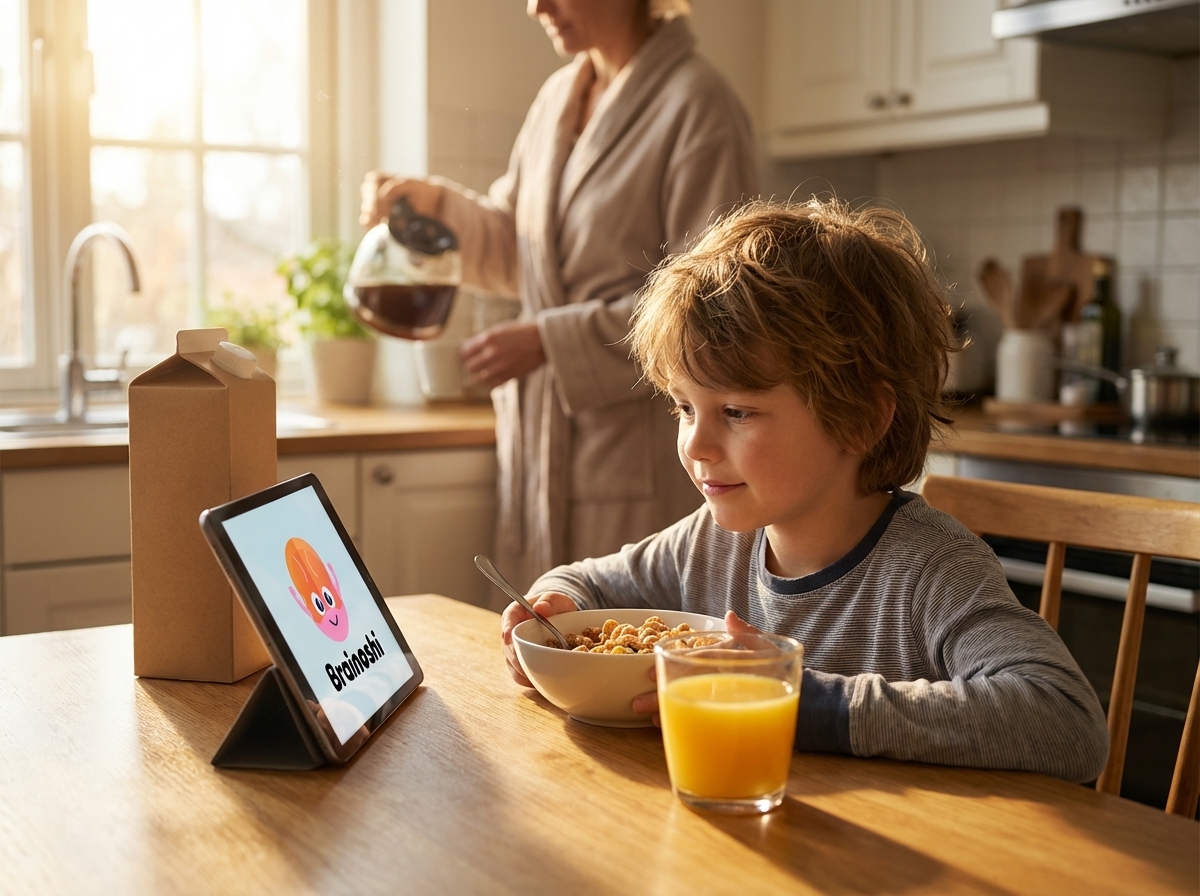
Pick one trigger and stick to it for the full week. After breakfast is ideal for most families because mornings are structured and predictable. The session should be about 10 minutes maximum. Stop at 10 minutes even if the child wants to continue — this builds anticipation for the next day.
Try BrainOshi free — see how it works in 10 minutes →
Week 2 — Remove friction
The app should be on the home screen, not buried in a folder. The account should already be logged in. Every extra tap between "I'm ready to learn" and "the first question is on screen" is a drop in probability that the habit happens. BrainOshi opens to the day's deck immediately after login — no navigation, no decisions, no choosing a subject. That matters more than it sounds.
Week 3 — Let the child own it
By week three, shift from "let's do your cards" to "have you done your cards today?" The goal is autonomous habit, not parental enforcement. Children who feel ownership over a routine maintain it longer and resist it less.
Week 4 onward — Track the streak
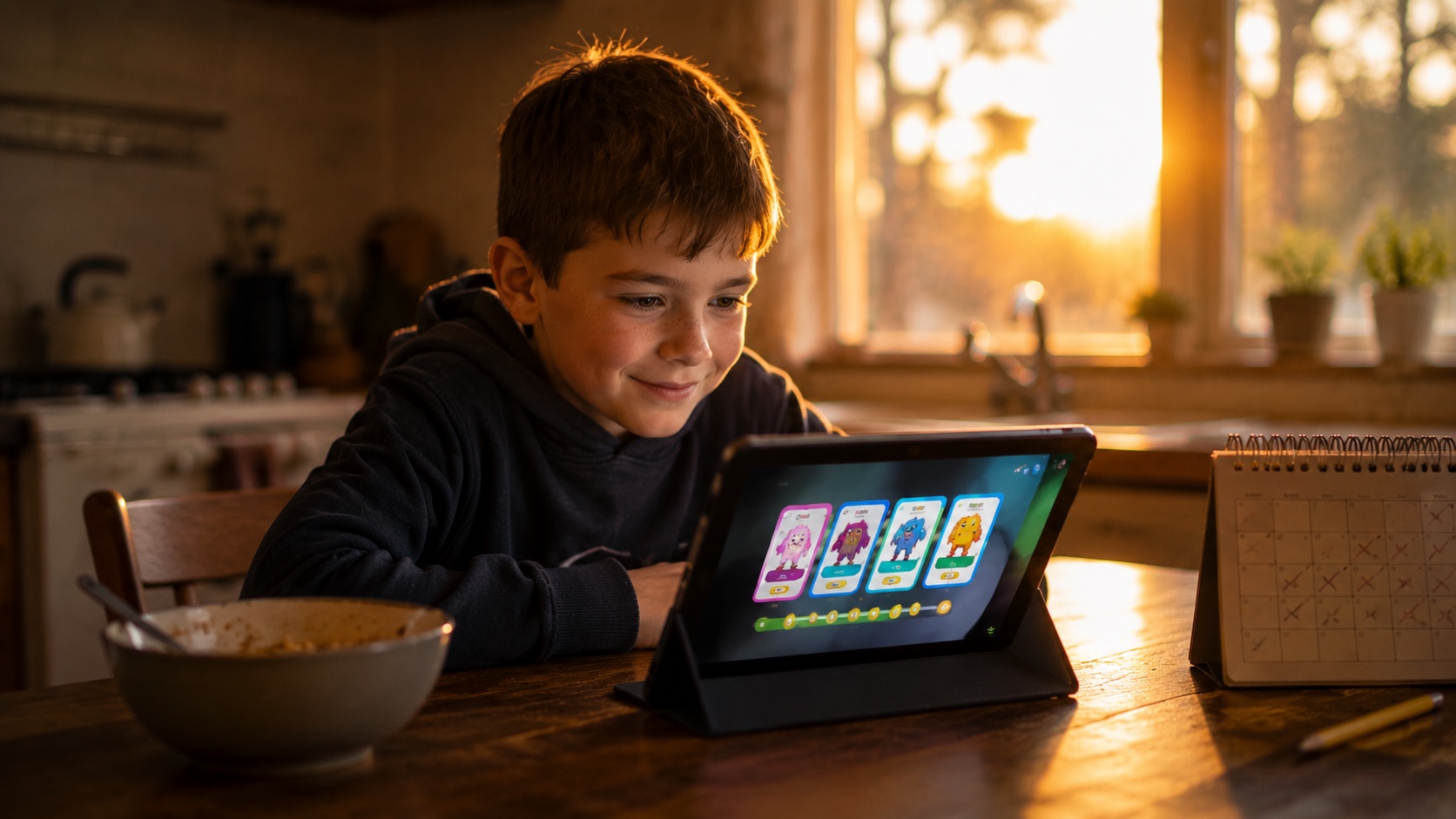
Streaks are a proven mechanism for habit maintenance. When your child has a 22-day streak, missing a day feels like a loss — not just an omission. BrainOshi tracks streaks natively — and unlike other apps, the streak is tied to multi-subject learning, not a single skill. A simple paper calendar on the fridge works too. The medium doesn’t matter. The daily habit does.
What 10 Minutes Actually Covers
Ten minutes of focused learning is more than it sounds when the format is right.
BrainOshi's daily deck is 10–15 cards — typically completed in 3 to 6 minutes depending on the child's age and reading speed. In a week, that's 70–100 cards across multiple subjects. In a month, 300+ cards. In a school year, over 3,000 individual knowledge checkpoints, each one reinforcing and building on the last.
Compare that to a school lesson: 45 minutes, one subject, reviewed once. The deck format wins on retention almost by default because the spacing is built in.
Real Scenarios: What This Looks Like at Home
The 7-year-old who hates homework
She doesn't think of BrainOshi as homework. It's the thing she does before watching cartoons. After 3 weeks, she asks to do it before her parents remind her. By month two, she's telling her dad facts about the solar system at dinner.
The 11-year-old who's bored at school
He's already ahead of most of his class in science, which makes him disengage. BrainOshi's cards stretch across subjects he doesn't get at school yet — medieval history, world geography, logic puzzles. He starts finishing the deck and asking if there are more.
The 14-year-old who thinks she's too old for "kid stuff"
Her parents frame it differently: "It's general knowledge. Like trivia, but you actually learn it." She uses the French-language setting because she's preparing for a school exchange. The format doesn't feel childish because the questions are genuinely challenging.
One Mistake to Avoid
Don't extend the session because things are going well.
If your child is engaged and wants to keep going on day 3, the temptation is to let it run. Resist it. A 10-minute habit that happens every day is worth more than a 20-minute session that happens twice a week. Consistency compounds. Duration does not.
When the deck is done, it's done. That's actually a feature, not a limitation.
The Compounding Effect
At 10 minutes a day, a child who starts at age 7 and maintains the habit until 15 will have spent roughly 240 hours in focused, spaced-repetition learning outside of school. That's six full school weeks of extra instruction, accumulated in daily increments small enough that no single day felt like a burden.
That's not a small number. And it starts with one card tomorrow morning.
Try BrainOshi Free — No Credit Card Required
Set up in under 3 minutes. Pick your child's age, choose the topics they enjoy, and their first daily deck is ready. The session ends on its own — no negotiation needed.
Start free at brainoshi.com →FAQ
How long does it take to build a learning habit in kids?
Research on habit formation (Lally et al., 2010, European Journal of Social Psychology) found that habits take an average of 66 days to form — not the commonly cited 21 days. For children, the range varies more widely. Expect 4–6 weeks before the routine feels automatic, and 3 months before it feels genuinely self-sustaining.
What's the best time of day for a learning routine?
Morning is most consistent because schedules are predictable. However, the best time is the one your child will actually keep. After school before screens, or after dinner before TV, works well for many families. Avoid bedtime — fatigue reduces retention.
Does 10 minutes of learning really make a difference?
Yes, if it's done daily. The research on spaced repetition is unambiguous: frequency matters more than duration. Ten daily minutes will outperform a 70-minute weekly session on long-term retention of the same material.
Should I sit with my child during the learning session?
For the first 1–2 weeks, yes. Your presence lowers resistance and signals that this is a priority. After that, the goal is independence. Check in on the streak, ask what they learned — but let them do the session alone.
What if my child misses a day?
One missed day breaks a streak but doesn't break a habit. Treat it as neutral and resume the next day. Avoid making it a consequence or a confrontation — that association will make the routine harder, not easier, to maintain.