I\'ve spent the last two years evaluating children\'s educational apps — reviewing their design decisions, talking to parents, and tracking how quickly kids abandon them. The number is consistent across dozens of products: most fail within the first two weeks of use.
That\'s not a parenting problem. It\'s not a "kids today" problem. It\'s a design problem. And once you see the patterns, you can\'t unsee them.
The Core Problem: Good Intentions, Bad Design
The children\'s educational app market is enormous. Parents spend real money on these products expecting them to supplement learning, build habits, and give kids something worth their screen time. In most cases, the app is opened enthusiastically for three or four days, used half-heartedly for another week, then quietly forgotten.
The apps themselves usually aren\'t bad in concept. The content is often solid. But concept and content don\'t determine whether a child comes back tomorrow. Design does.
The 4 Design Failures That Kill Educational Apps
Failure #1: No Natural Stopping Point
Most educational apps are built like social media feeds — there\'s always one more question, one more level, one more challenge. The session never ends. The app just keeps going until a parent pulls the device away.
This creates a structural problem. Kids can\'t feel a sense of completion because there\'s no finish line. Every session ends in conflict — a parent interrupting, a frustrated child, a negotiation about "five more minutes." That friction accumulates. Within two weeks, the app has become associated with conflict rather than reward.
There\'s also a behavioral science angle: completion is itself a motivator. When children can finish something — close it out, see their results, feel the satisfaction of being done — they\'re more likely to want to repeat that experience tomorrow. Infinite scroll removes that entirely.
Failure #2: The Wrong Reward at the Wrong Time
Many educational apps save their rewards for milestones: finish 20 lessons, earn a badge. Complete 30 days in a row, unlock a new character. The rewards are there, but they\'re weeks away.
That\'s not how children\'s motivation works. Behavioral research is consistent: for reward systems to drive repeated behavior, the feedback loop needs to be tight. Rewards that come days or weeks after the behavior have little effect on the brain circuits that build habits.
The other missing ingredient is variability. Predictable rewards become invisible quickly. Variable rewards — the possibility of something unexpected — sustain engagement far longer. This is why collectible card mechanics hold children\'s attention in ways that purely digital quiz formats struggle to match.
Failure #3: Learning Disguised as School
There\'s a paradox at the heart of many educational apps: the more they look like school, the less children want to use them.
Apps built around lesson structures and question formats that mirror classroom tests are fighting an uphill battle. Children don\'t come home from school and think "I\'d love to do more of that on my phone." When an app triggers the same associations as homework, it inherits the same resistance.
The apps that succeed don\'t hide that they\'re educational — but they package learning inside formats that feel like play. The child\'s experience of the session is fun first. The learning happens anyway, often more effectively because engagement is higher.
Failure #4: One-Size-Fits-All Content
A ten-question quiz that works well for a nine-year-old will bore a thirteen-year-old and frustrate a seven-year-old. Static difficulty is a design choice that guarantees the app will be wrong for most of its users most of the time.
When content is too easy, children disengage within days. When it\'s too hard, they give up and associate the app with failure. Adaptive difficulty — adjusting in real time based on recent performance — is essential. The apps that skip it are accepting a hard ceiling on how well they can serve any individual child.
What the Apps That Actually Work Do Differently
The rare educational apps that hold children\'s attention past the two-week mark share a consistent set of characteristics. They\'re not necessarily the most content-rich or the most expensive. But they all address the four failures above.
They have a built-in stopping point. The session ends on the app\'s terms, not the parent\'s. When a child finishes, they feel done — not interrupted. That completion feeling is what makes them want to start again tomorrow.
They reward immediately and variably. Points for today\'s session, a streak counter, and an element of unpredictability — a rare card, a surprise result — keep attention alive and feedback tight.
They feel like play, not school. The formats are interactive, the pacing is fast, and nothing on the screen looks like a worksheet. The educational content is real, but the experience of consuming it is genuinely fun.
They adapt to the child, not the average. Difficulty adjusts based on recent accuracy, so children who are doing well get pushed harder, and children who are struggling get brought back to solid ground.
An App That Gets All Four Right
I don\'t usually call out specific products in these analyses, but when something genuinely solves the problems I\'ve been describing, it\'s worth noting.
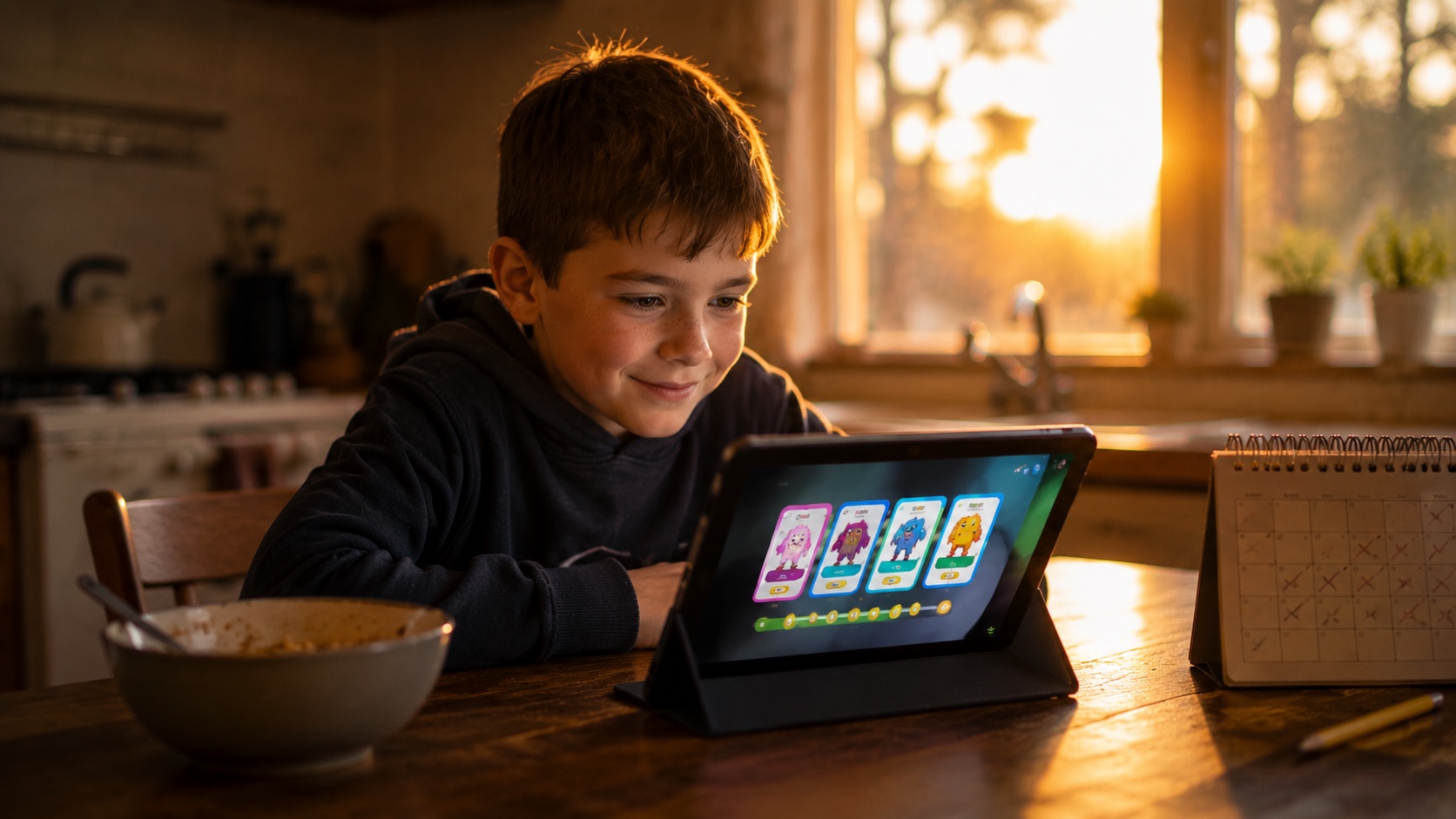
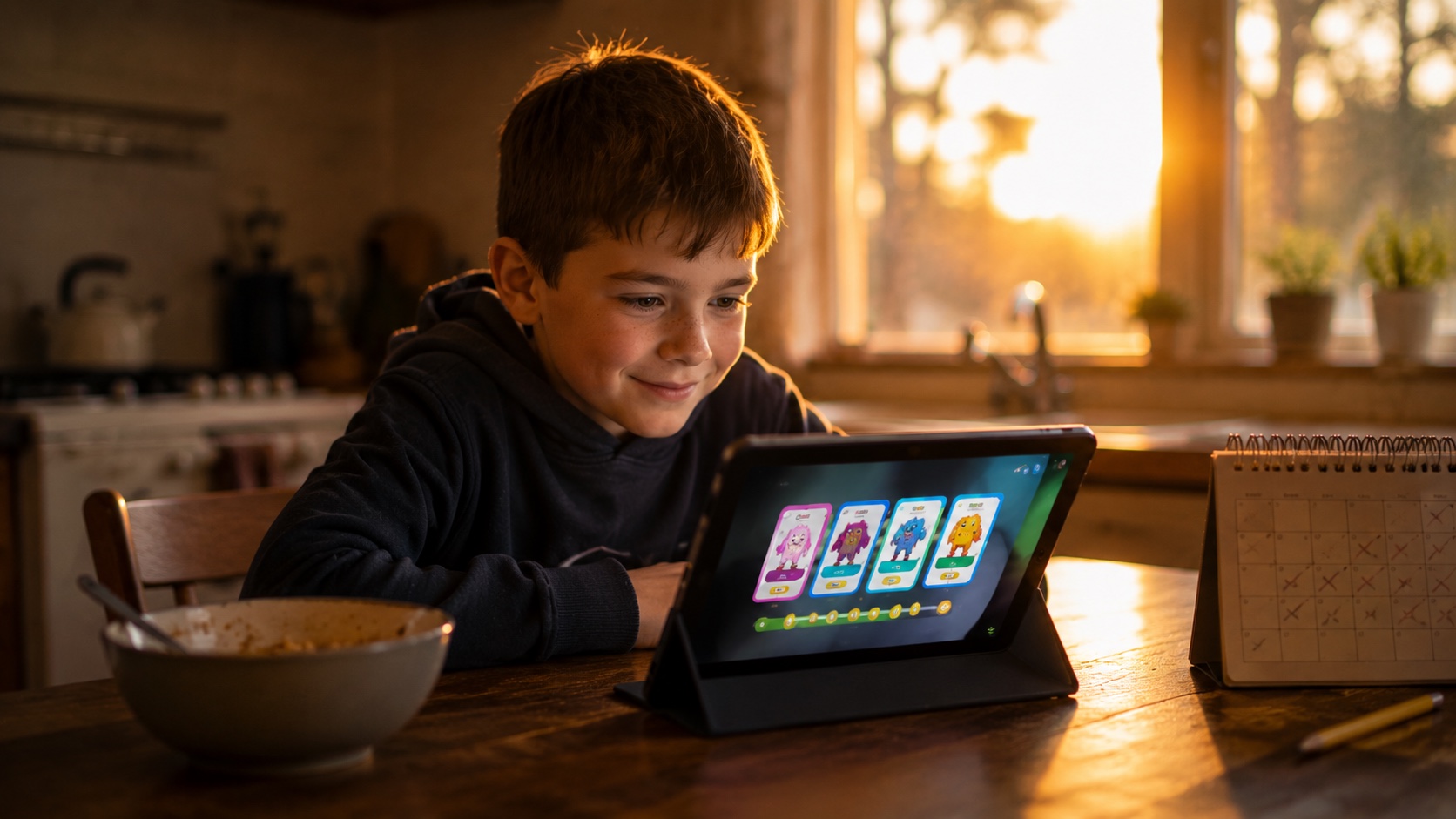
BrainOshi is a daily learning app for kids that was clearly designed around these exact principles. Each session is a finite deck of 10 to 15 cards — it ends automatically. No scroll, no autoplay, no negotiation. When your child finishes, the screen shows results and closes. Done.
The reward system combines daily streaks with a card rarity mechanic (Common, Rare, Epic, Legendary) that introduces genuine variability. Children don\'t know which card they\'ll get next, which makes each session feel different even when the format is consistent.
The content covers seven subjects — science, history, geography, math, languages, general knowledge — presented through interactive formats that don\'t look like school. Boss battles and challenges replace the lecture-then-quiz structure that kills engagement on most platforms. Difficulty adapts based on recent performance.
What is BrainOshi?
BrainOshi is a daily educational app for kids aged 6-15 that replaces doom-scrolling with a short, finished deck of interactive learning cards. Ten minutes a day, seven subjects, adaptive difficulty — and a reward system that actually works on children\'s brains.
→ Try it free at brainoshi.com
A Parent\'s Checklist Before Downloading Any App
- Does the session end on its own? If you have to interrupt your child to stop a session, the app is working against you.
- Does your child get rewarded today? Not in three weeks. Today. Badges that take months to earn don\'t build habits.
- Does it look and feel like a game? If your child says it feels like homework, it\'ll be abandoned within a week.
- Does the difficulty adjust? Ask after a few sessions whether the content still feels appropriately challenging.
- Can you see what\'s actually happening? A parent dashboard with real data is a sign the product was built with parents in mind, not just children.
The two-week drop-off rate for educational apps isn\'t inevitable. It\'s a consequence of specific, fixable design decisions. The apps that solve those problems hold children\'s attention for months and build genuine learning habits.
Those apps exist. They\'re just not the majority.
→ See how BrainOshi approaches each of these problems
Try BrainOshi Free — No Credit Card Required
Set up a profile for your child in under two minutes. The first deck starts immediately — no paywall. See whether the format works before you spend anything.
Start free at brainoshi.com →FAQ
Why do most educational apps for kids fail within two weeks?
The most common reasons are structural. Apps without a natural stopping point create daily conflict between parents and children. Apps with delayed reward systems fail to reinforce the habit before it forms. Apps that look and feel like school inherit children\'s resistance to schoolwork. And apps with static difficulty either bore children who are doing well or frustrate children who are struggling.
What makes a children\'s educational app actually stick long-term?
Four things matter most: a finite session that ends on its own, rewards that come today, a format that feels like play rather than homework, and difficulty that adapts to the individual child\'s recent performance. Apps that hit all four can hold engagement for months rather than days.
Is screen time for educational apps different from screen time for entertainment?
The type of engagement matters more than the raw time. Passive consumption — autoplay video, infinite scroll — has different effects than active participation in short, finished tasks with immediate feedback. An educational app that ends naturally after ten minutes and adapts to the child\'s level is meaningfully different from entertainment apps designed to maximize session length.
How do I know if an educational app is actually teaching my child anything?
Look for three signals. First, does your child get questions wrong sometimes? Apps that only show easy content aren\'t pushing learning. Second, can you see accuracy data by subject in a parent dashboard? Vague metrics like \'sessions completed\' tell you nothing. Third, does your child retain anything after a few weeks?
What subjects should a good educational app cover for kids aged 6-15?
The most effective apps cover a mix of core subjects and broader knowledge: science, mathematics, history, geography, and language skills, plus general knowledge and cultural topics. Coverage across multiple subjects allows the app to adapt to a child\'s interests, which increases voluntary engagement.