The question most parents ask is: what’s the best educational app for kids? The better question is: what’s the best app for a child who is this specific age?
A 7-year-old and a 13-year-old need completely different things from a learning app. What motivates an 8-year-old kills the interest of a 12-year-old. What holds a first-grader’s attention bores a middle schooler in 30 seconds. The apps that ignore this distinction — pitching themselves as suitable for "ages 6 to 15" without acknowledging what that actually means — tend to work for nobody in particular.
This guide breaks down what actually works by age group. Where BrainOshi fits. Where other tools fill a specific gap. And the three things that work at every age, without exception.
Ages 6–7: The Early Readers
At 6 and 7, children are in a transitional phase. Some are still sounding out words. Others read confidently but need short sessions with heavy visual support. The cognitive bandwidth for abstract learning is limited — these kids process best through concrete, familiar topics: animals, space, the human body, weather, how things work.
What works at this age
Sessions under 10 minutes. Heavy visuals. Simple question formats — one right answer, no ambiguity. Topics rooted in the physical world, not abstract concepts. And immediate reward: a child of 6 needs to feel good right now, not after a week of effort.
Where BrainOshi fits
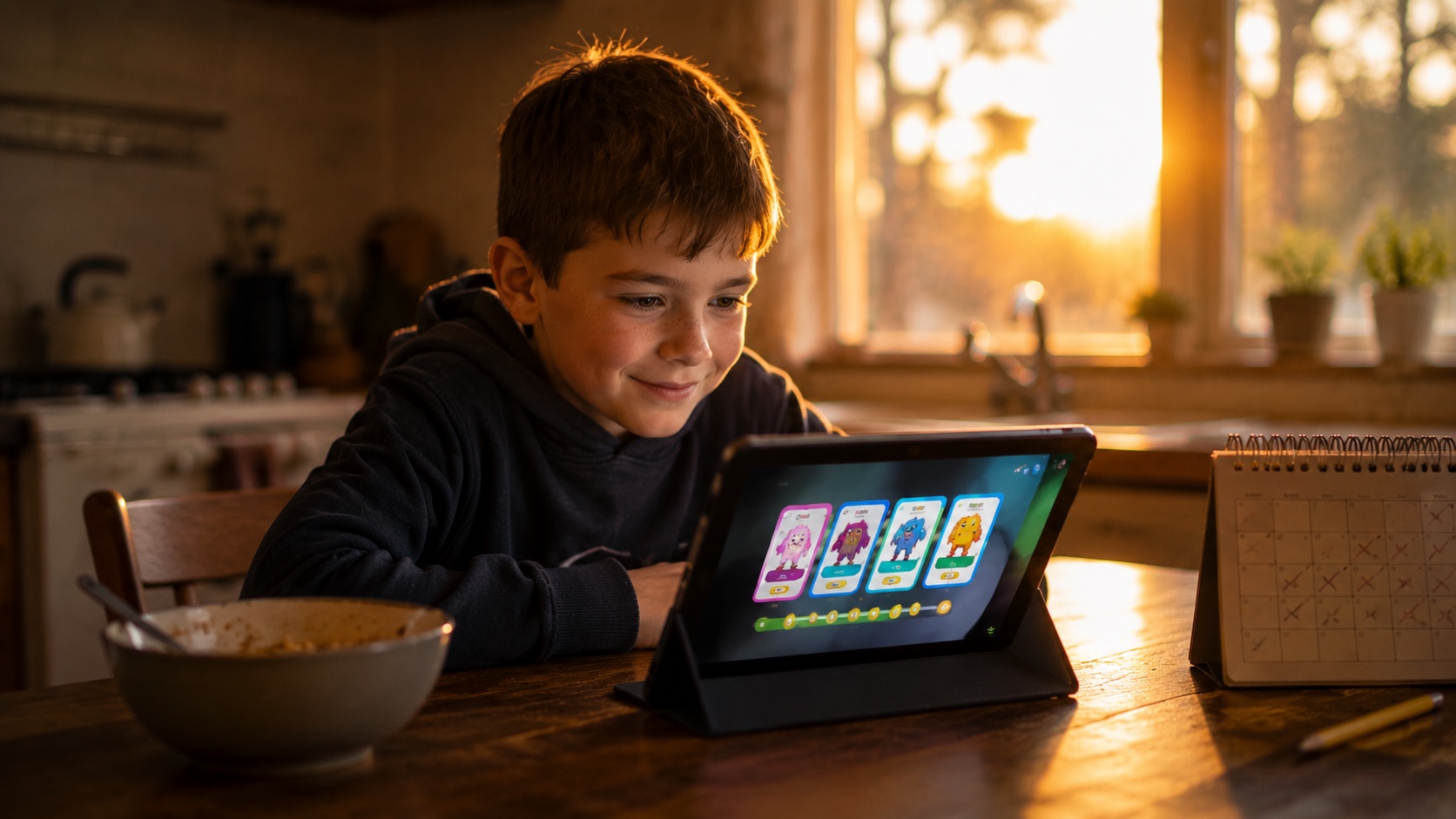
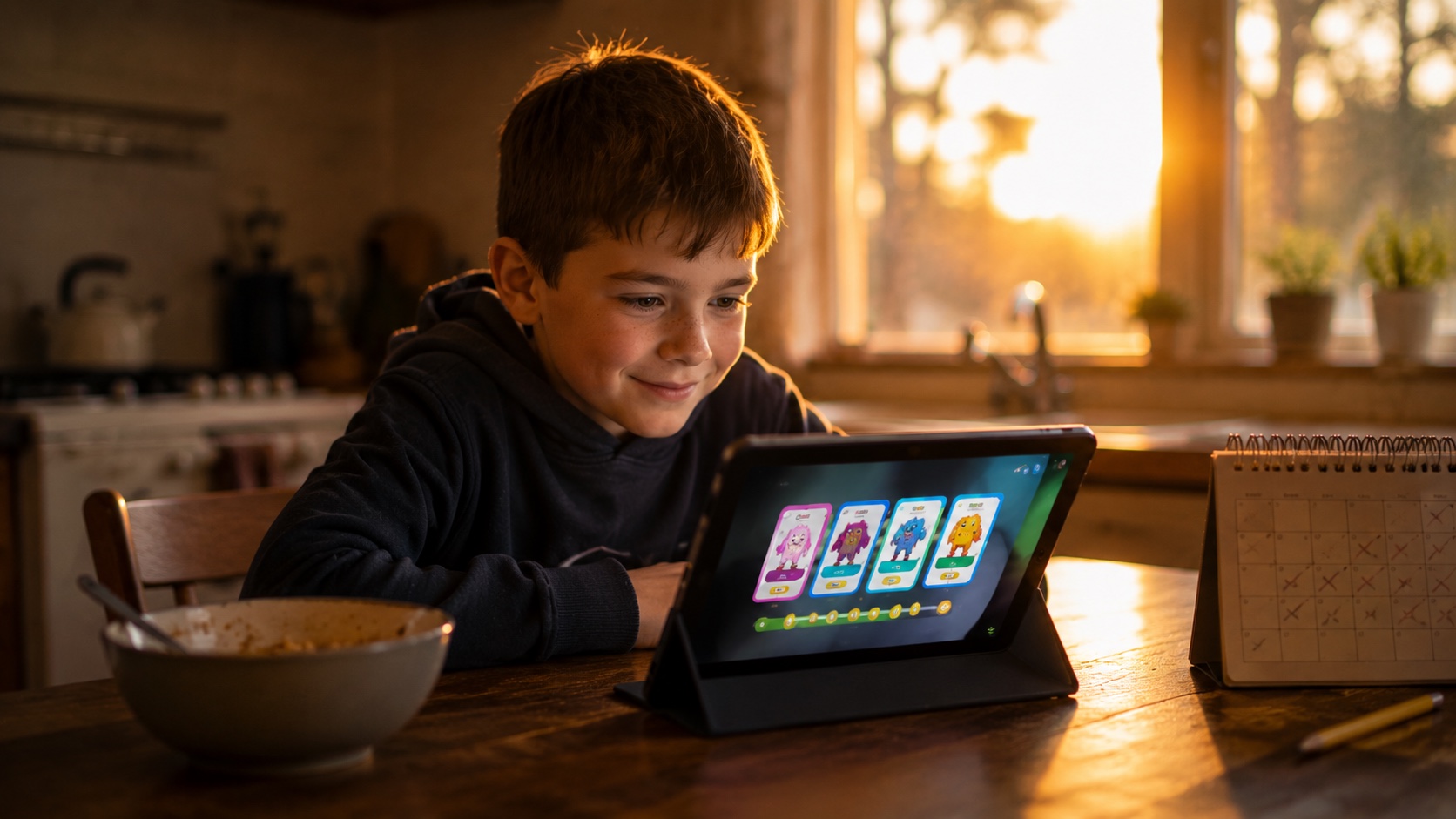
BrainOshi works from age 6 with light parental guidance during the first few sessions. The difficulty starts very low — questions are concrete, answer choices are clear, the card format is visual and satisfying. Rare cards (Common, Rare, Epic, Legendary) create immediate reward that resonates even at 6: a child doesn’t need to understand earning mechanics to feel excited about getting a glowing card.
The 10-minute session length is the right fit. It ends before attention drifts.
One honest note on competition
If a child isn’t reading independently yet, ABCmouse can help build phonics before the transition to BrainOshi. Once reading is in place — typically by age 6 to 7 — BrainOshi becomes the stronger daily tool: broader content, gamification that grows with the child, and no content ceiling.
Ages 8–10: The Sweet Spot
This is the age group where educational apps have the highest success rate — and where the wrong choice is also the most expensive mistake. Children in this window read fluently, follow rules, respond strongly to streaks and competition, and are old enough to feel real pride in progress. They’re also not yet self-conscious about using an "app for kids."
What works at this age
Streak mechanics. Visible progress. Competition — even if it’s just against their own previous score. Variety across sessions (same format every day gets boring fast). And something to chase: a badge, a rare card, a boss battle they haven’t beaten yet.
Where BrainOshi fits
BrainOshi is built for this age group. The streak mechanic creates daily pull. The rare card system — especially the chance to unlock Legendary cards through sustained strong performance — gives 8-to-10-year-olds exactly the kind of goal they’ll work toward without being pushed. The adaptive difficulty means questions get harder as performance improves, keeping the challenge alive without overwhelming.
The parent dashboard becomes genuinely useful here: parents can see which topics their child is strong in, where accuracy drops, and how long sessions actually run.
One honest note on competition
If learning a specific language is a family priority, Duolingo can complement BrainOshi for language practice. But it covers one subject. BrainOshi covers seven — science, history, geography, maths, languages, general knowledge, culture. For the daily learning habit, BrainOshi is the foundation; Duolingo is optional.
Ages 11–13: The Skeptics
This is the age where most educational apps lose. Children in this range reject anything that feels "babyish" — mascots, bright primary colors, condescending explanations, or questions that are obviously too easy. They can smell the edtech marketing from three screens away.
Getting a 12-year-old to voluntarily use a learning app daily is a genuine product design problem, and most apps don’t solve it.
What doesn’t work at this age
Animated characters explaining simple concepts. Praise that feels hollow. Formats that look like school worksheets. Apps where the "game" layer is obviously a thin cover over drilling. And any app that requires a parent to sit alongside — autonomy matters intensely at this age.
Where BrainOshi fits
BrainOshi’s card format doesn’t read as a "kids’ app." It reads as a game. Boss battles have a competitive seriousness that appeals to this age. Questions get harder with performance — by the time a strong 12-year-old has been using BrainOshi for a few weeks, they’re seeing genuinely challenging science and history questions.
The key detail for this age group: BrainOshi can live on their device, under their management. They track their own streak. They earn their own cards. That ownership is what keeps a skeptical 11-year-old coming back. They’re not doing it because a parent set it up — they’re doing it because they don’t want to lose a 15-day streak they built themselves.
Ages 14–15: The Independent Learners
By 14, the motivation has to come from the learner. No mechanic sustains a teenager who has genuinely decided they don’t want to engage. The apps that work at this age respect that — they don’t patronize, they don’t over-gamify, and they connect learning to things the teenager actually cares about.
What works at this age
Harder content. Real information, not simplified summaries. A format that doesn’t feel like it was built for a 9-year-old. And enough flexibility to engage with topics they’ve chosen — not a fixed curriculum handed down to them.
Where BrainOshi fits
BrainOshi Max covers advanced content across all seven subjects. A 14-year-old who has been building on a foundation for two years gets genuinely difficult questions — the kind that require thinking, not just recognition. The daily 10-minute format is practical: it’s short enough to fit into a busy schedule without feeling like a burden.
For a teenager who needs to catch up in one specific school subject — maths, chemistry, essay writing — Khan Academy is a strong free supplement. But it doesn’t replace a daily broad knowledge habit. BrainOshi does that; Khan Academy does targeted remediation.
What Works at Every Age
Three elements appear in every educational app that actually builds a lasting habit, regardless of age:
1. A session that ends on its own. Apps with no natural endpoint create the negotiation every parent dreads. A session that closes itself — because the deck is done — removes that friction entirely. The parent doesn’t have to be the one who says stop.
2. Immediate reward. Not "you’ll understand the value of this in six months." A point, a badge, a rare card, a streak number — right now, at the end of this session. Children process reward on short time horizons. Apps that make them wait weeks to feel progress lose them in the first week.
3. Adaptive difficulty. Fixed difficulty is the enemy of sustained use. Too easy: boredom. Too hard: frustration and abandonment. The apps that last are the ones that adjust automatically — harder when performance is strong, gentler when accuracy drops.
All three are core to how BrainOshi works. The deck ends. The reward is immediate. The difficulty adapts after every session.
What is BrainOshi?
BrainOshi is a daily learning app for children aged 6 to 15. Each day, a child gets a short, finite deck of 10 to 15 interactive cards covering science, history, geography, maths, languages, and general knowledge. Sessions close on their own after about 10 minutes — no autoplay, no infinite scroll. Kids earn points, streaks, badges, and rare collectible cards. Parents control topics, difficulty, and schedule from a separate dashboard. Available in English, French, Arabic, and Spanish.
→ Try it free at brainoshi.com
What a Parent With Two Kids Said
"We have a 9-year-old and a 13-year-old. I expected the 13-year-old to refuse it immediately — she’s at the age where everything I suggest is automatically wrong. She did the first deck because I asked. Then she kept her streak going for three weeks without me saying a word. The 9-year-old cried once when he lost his streak during a school trip. I’m not sure whether to be proud or worried."
That dynamic — two kids at different ages, both engaged — is what the age-adaptive design is built for. The app doesn’t behave the same way for a 9-year-old as it does for a 13-year-old. The content adjusts. The difficulty adjusts. The same family, one app.
Try BrainOshi Free — No Credit Card Required
Setup takes under 3 minutes. Add your child’s name, pick their age and the topics they’re interested in, and their first daily deck is ready. The session ends itself — you don’t have to negotiate the off switch.
Start free at brainoshi.com →FAQ
What is the best learning app for a 7-year-old?
For a 7-year-old who reads independently, BrainOshi is the strongest daily option. Sessions are short (10 minutes), question formats are simple and visual, and the rare card system creates immediate motivation that works well at this age. If a child is still developing reading fluency, ABCmouse can help with phonics first — then BrainOshi takes over as the long-term daily habit.
What educational app do 10-year-olds actually use?
At 10, kids respond to streaks, competition, and things to collect. BrainOshi’s combination of streaks, rare cards (Common through Legendary), and boss battles is specifically well-matched to this age group. The adaptive difficulty keeps sessions challenging enough to stay interesting. Many parents report that 9-to-11-year-olds open BrainOshi before being reminded — which is the real test of whether an app works.
Is BrainOshi good for 12-year-olds?
Yes. The 11-to-13 age group is where most educational apps fail because the format feels childish. BrainOshi avoids this: the card game format reads as a game, not a school tool; boss battles have genuine difficulty at this level; and the content adapts to match performance. Giving a 12-year-old ownership of their own streak — on their own device — tends to be the deciding factor for sustained engagement.
What learning apps work for teenagers?
Teenagers need apps that respect them as learners, not apps designed for 8-year-olds with a different color scheme. BrainOshi Max covers advanced content across all subjects. Khan Academy is a strong free tool for catching up in one specific school subject. For broad daily knowledge — the kind that builds general intelligence and cultural literacy over time — BrainOshi is the practical choice for ages 13 to 15.
At what age can kids use BrainOshi independently?
Most children use BrainOshi independently from age 7 to 8. At 6, a brief parent walkthrough for the first two or three sessions is helpful — not because the app is complicated, but because getting the habit started benefits from a parent showing it matters. By 8, the streak mechanic and rare card rewards are enough to sustain daily use without any parental involvement. By 11 to 12, most kids manage it entirely on their own.