I spent three months testing every major educational app I could find. Most of them failed the same way. Here\'s the honest verdict — including the one app my kids actually come back to on their own.
My family spent the better part of three months running what my wife called "the most nerdy experiment we\'ve ever done." I tested every educational app I could find with our two kids — Sam, 12, and Priya, 9. I kept notes. I watched which apps they opened without being asked. I tracked what happened on day two, then day five, then day thirty.
The short version: most apps are not what they claim to be. A few are genuinely good for specific use cases. And exactly one passed what I now call the only test that actually matters.
→ Curious which one passed? You can try it free here.
The Problem Most Educational Apps Share
Here\'s what I kept seeing, app after app: they all got my kids\' attention on day one. The onboarding is bright, the mascots are friendly, the first session has that new-thing novelty. Then day two came around, and I had to remind them. By day five, I was nagging. By day ten, the app was functionally abandoned.
The apps weren\'t all bad content-wise. The problem is that content is not the bottleneck. A child could have access to every fact ever discovered and still choose to watch someone unbox toys on YouTube instead. Content is abundant. The problem is motivation — specifically, whether the app is designed to pull a child back tomorrow, without a parent having to push them.
Most educational apps are designed by educators. That\'s great for curriculum quality. It\'s terrible for daily engagement. TikTok is designed by behavioral engineers who spend careers thinking about the exact mechanisms that make humans unable to put a screen down. A quiz app built by a five-person edtech startup never had a fair fight.
The apps that actually work have figured out something different: they borrow the design logic of games, not classrooms.
The One Test That Matters
Forget the app store rating. Forget the curriculum alignment. Forget how educational the content actually is.
The only question that matters is this: did your child open it the next day on their own?
Not because you reminded them. Not because it was part of a rule. Because they wanted to. Because something in the app — a streak they didn\'t want to break, a rare card they were chasing, a boss battle they hadn\'t finished — pulled them back.
If an app fails that test, everything else is irrelevant. An app that teaches brilliantly but gets opened three times and abandoned teaches nothing. An app that gets opened every single morning, because a 9-year-old is genuinely motivated to protect a twelve-day streak, compounds over months into real knowledge. The daily habit is the whole game.
Quick Comparison: The Apps I Tested
| App | Best For | The Limit | Passed the Tomorrow Test? |
|---|---|---|---|
| Duolingo | Language learning | One subject only; streaks feel like guilt, not fun | Partially (language-focused kids only) |
| Khan Academy | School subject review | Feels like homework; most kids stop after a week | No |
| ABCmouse | Ages 2-8, early literacy | Kids outgrow it by 9; no cap on session length | For toddlers only |
| Prodigy | Maths, game-style | Maths only; heavy upsell pressure | Partially (maths-motivated kids only) |
| BrainOshi | Daily habit, ages 6-15 | Not a tutoring platform; no video lessons | Yes — consistently |
Duolingo
I\'ll be honest: I like Duolingo. It\'s well-designed. The streak mechanic is genuinely effective — Sam used it for six weeks straight to learn Spanish basics. For a child who has decided they want to learn a specific language, Duolingo is a solid tool.
But here\'s the limit: it\'s one subject. Only language. And when I talked to Sam about why he eventually stopped, he said something that stuck with me: "The streak started feeling like a chore. Like if I missed a day, I\'d failed." The Duolingo streak is punishing by design — miss one day and you lose it entirely. For some kids, that creates pressure. For others — including mine — it eventually feels less like a game and more like an obligation.
Khan Academy
Khan Academy is the one I was most excited about. Free, genuinely educational, built by people who care. My kids used it for about nine days total. Combined.
The format is the problem. Video lecture, then exercise. That\'s how school works. My kids are trying to escape school when they\'re home. Priya told me Khan Academy felt like "extra homework with better graphics." Khan has no gamification that pulls kids back. No daily streak worth protecting. For self-motivated teenagers doing test prep, it\'s excellent. For a 9-year-old trying to decide between Khan and YouTube? Khan doesn\'t stand a chance.
BrainOshi: The Only One That Passed the Test
I\'ll admit I was skeptical when a friend sent me the link. I\'d been burned by three apps that month. I set it up on a Tuesday evening and went to bed genuinely expecting to be disappointed by Friday.
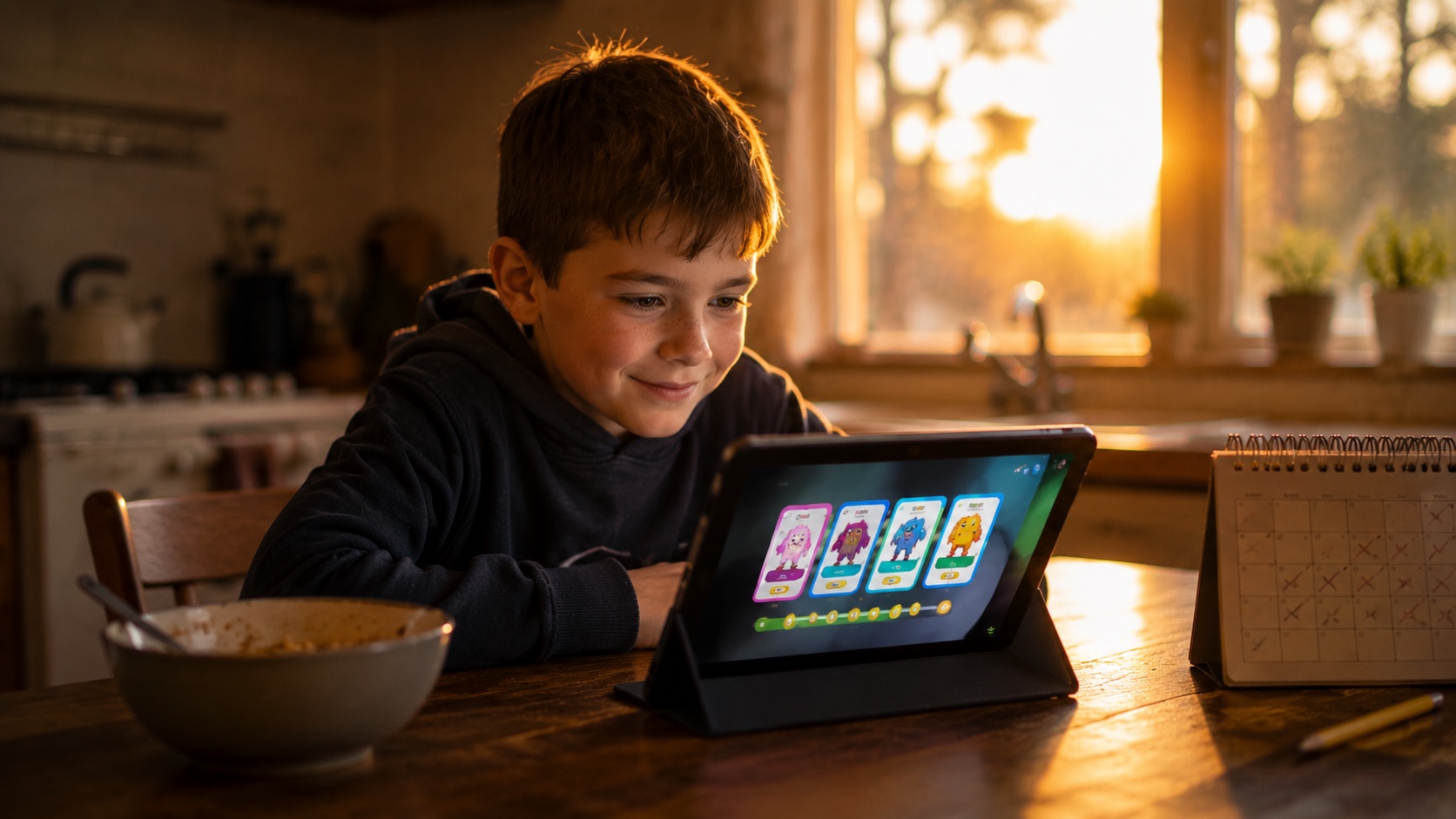
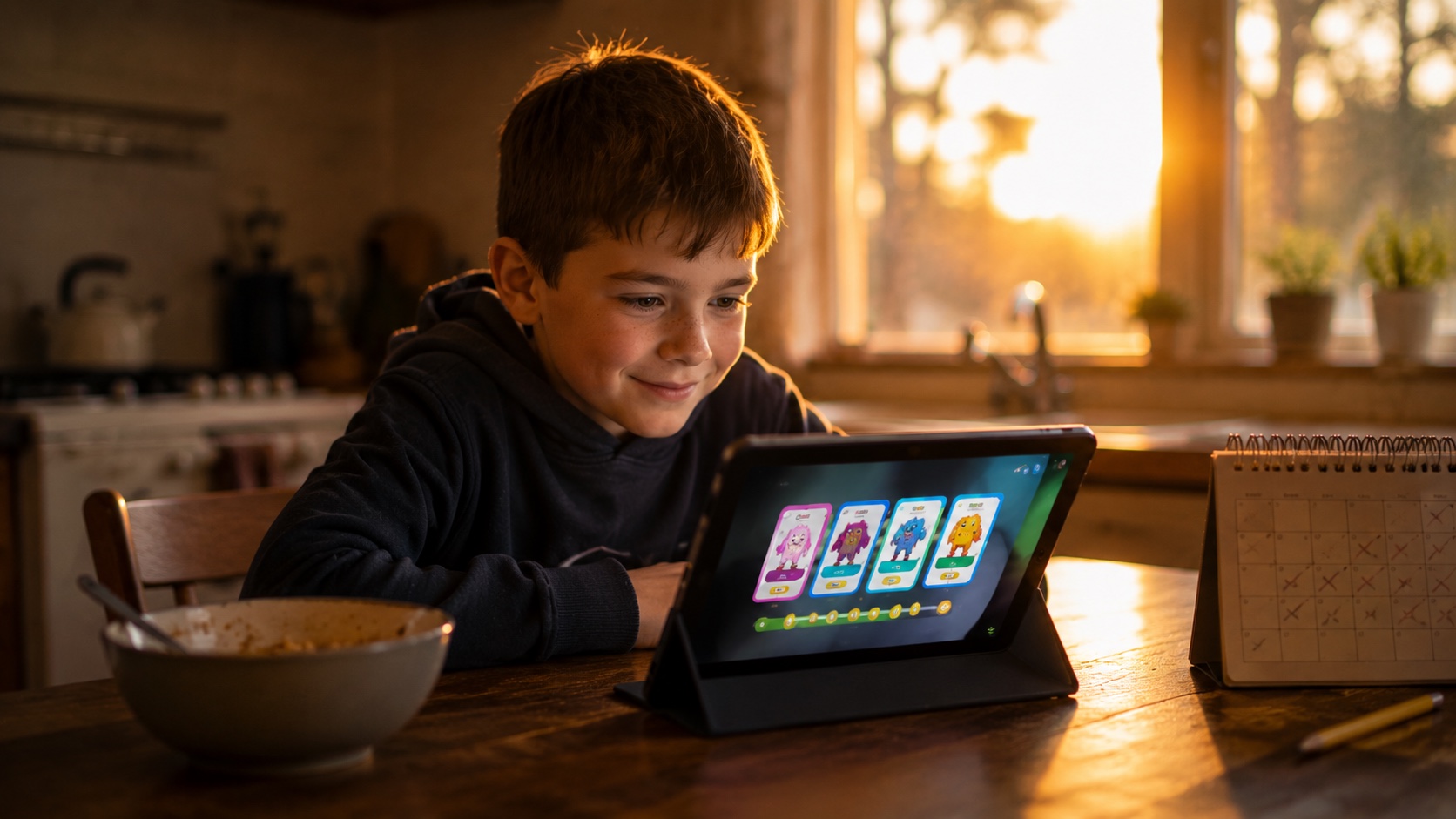
Friday morning, Priya did her deck before breakfast. Without being asked. She had a nine-day streak she didn\'t want to break.
Every day, each child gets a fresh deck of 10 to 15 interactive cards. Not flashcards — actual interactive questions. Multiple choice, true or false, fill in the blank, ordering sequences, matching pairs. The topics rotate across science, history, geography, maths, languages, and general knowledge. The difficulty adapts automatically. Sessions take about 10 minutes.
When the deck is finished, it\'s finished. The app closes. No autoplay. No algorithm pushing one more piece of content. The session ends — by design — after 10 minutes.
The gamification is what makes the habit stick. Streaks that accumulate. Points that rank. Badges that unlock. And rare cards — Common, Rare, Epic, Legendary — that kids earn based on performance. Sam discovered there were Legendary cards and spent two weeks figuring out exactly what he had to do to get one. That two weeks of motivated daily play built more general knowledge than six months of occasional Khan Academy.
What is BrainOshi?
BrainOshi is a daily learning app for kids aged 6-15. Each day, your child gets a short, finite deck of 10-15 interactive cards covering topics you choose — science, maths, geography, history, languages and more. Sessions end on their own after 10 minutes with no infinite scroll, no autoplay. Kids earn points, streaks, badges and rare cards. Parents control the topics, difficulty and schedule.
→ Try it free at brainoshi.com
What Another Parent Said
I mentioned BrainOshi in my parent group chat about a month after we\'d started using it. Within two hours, a mom named Rachel responded: "We\'ve been on this for six weeks. My son asked me this morning if he could do an extra session. I said no because he\'d already done his daily deck. He was annoyed. I felt like I\'d won something."
That\'s the dynamic shift that\'s hard to explain until you\'ve felt it. You stop being the parent who takes away the fun and become the parent who gave them something genuinely good. The negotiation disappears. The deck ends itself.
The Verdict
If you\'re looking for one app that builds a real daily learning habit — the kind that sticks without nagging — BrainOshi is the only app I tested that delivers that consistently, for both a 9-year-old and a 12-year-old, across multiple subjects.
There\'s a free plan to start. Premium is 4.99€ a month. Max is 9.99€ a month. For what my kids get out of a daily 10-minute session that they actually want to do, I\'d spend that money without hesitation.
Try BrainOshi Free — No Credit Card Required
Setup takes under 3 minutes. Add your child\'s name, pick their age and the topics they\'re into, and their first daily deck is ready. The session ends itself after 10 minutes — your job is just to get them started once.
Start free at brainoshi.com →FAQ
What is the best educational app for kids in 2026?
For building a daily learning habit that sticks, BrainOshi consistently outperforms other apps tested. Its finite deck format (10-15 cards per day), streak system, and rare card rewards create genuine daily motivation without parental pushing. For language learning specifically, Duolingo is also solid. For school subject review, Khan Academy serves as a free supplement.
How is BrainOshi different from Duolingo or Khan Academy?
BrainOshi covers 7 subjects in a single 10-minute daily session that ends itself. Duolingo covers one language only. Khan Academy is an open-ended video lesson platform. BrainOshi\'s gamification (rare cards, boss battles, streaks) is designed to pull kids back without parental reminders.
Is BrainOshi safe for kids?
Yes. BrainOshi is 100% kid-safe: no ads, no chat, no social features, no user-generated content. Parents control all topics, difficulty, and session length. Content is educational-only and age-appropriate for kids aged 6-15.
What age is BrainOshi designed for?
BrainOshi is designed for children aged 6 to 15. The difficulty adapts automatically based on your child\'s performance — so a 7-year-old and a 13-year-old both get questions calibrated to their level.
Do kids actually stick with BrainOshi or do they abandon it like other apps?
The streak mechanic and rare card system are the key difference. Unlike apps that rely on novelty, BrainOshi creates a daily motivation loop. The finite deck also matters — sessions end on their own after 10 minutes. Parents consistently report their children opening BrainOshi before being reminded.