MentalUP uses cognitive puzzles to train memory, attention, and processing speed. BrainOshi uses educational cards to build actual knowledge — facts, concepts, vocabulary. MentalUP exercises the brain. BrainOshi fills it. Here's when each one matters.
The Fundamental Distinction
MentalUP is a brain-training app. Its exercises — visual memory, pattern recognition, spatial reasoning — are designed to improve cognitive performance. Think of it like a gym for the mind. You leave fitter, but you haven't learned anything specific about the world.
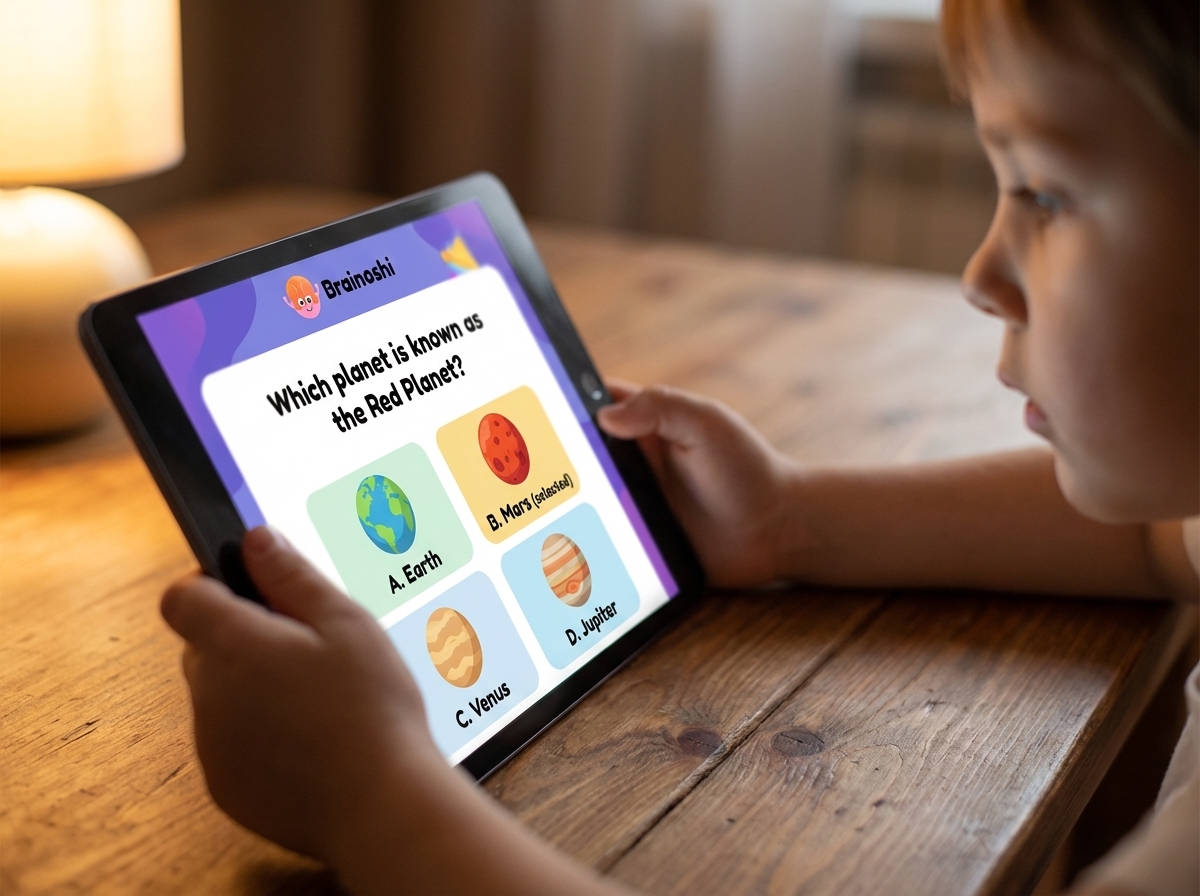
BrainOshi is a knowledge app. Your child finishes a session knowing what the capital of Peru is, or why the sky is blue, or how to say "river" in Arabic. The cards deliver real educational content, not abstract cognitive drills.
Both approaches have value. But they're not the same thing.
Side-by-Side Comparison
| Feature | BrainOshi | MentalUP |
|---|---|---|
| Core purpose | Build real-world knowledge | Train cognitive skills |
| Format | 10–15 interactive cards/day (quiz, true/false, QCM) | Cognitive games and puzzles |
| Content | Science, history, geography, maths, languages | Memory, attention, logic, visual skills |
| Age target | 6–15 years | 4–13 years |
| Daily time | ~10 minutes | 20+ minutes |
| Gamification | Streaks, badges, rare cards | Stars, rewards, progress charts |
| Parent dashboard | Yes | Yes (detailed cognitive reports) |
| Languages | EN / FR / AR / ES | 15+ languages |
| Video content | No | No |
| Free tier | Yes (limited) | Yes (limited) |
| Paid plan | $4.99/mo or $9.99/mo | ~$9.99/mo |
| Screen time cap | Deck closes after 10–15 cards | No built-in daily cap |
Try BrainOshi free — see how it works in 10 minutes →
What MentalUP Does Differently
MentalUP focuses on abstract cognitive puzzles — memory games, pattern matching, spatial reasoning. If a specialist has specifically recommended cognitive exercises for your child, it serves that niche. But for most families, the question worth asking is: after 20 minutes of abstract puzzles, what has your child actually learned about the world? The answer is nothing concrete. No facts about science. No vocabulary. No understanding of history or geography.
MentalUP also requires 20+ minutes per session with no built-in daily cap. At ~$9.99/month, it costs the same as BrainOshi’s Max plan while covering zero academic content. BrainOshi gives you cognitive challenge through real-world problem-solving AND fills your child’s brain with actual knowledge.
Where BrainOshi Wins
BrainOshi wins when you want your child to actually know things. Puzzle games make a child faster at puzzles. They don't teach them that the Amazon River is in South America, or that sound travels slower than light, or that "bonjour" is French for "hello."
This is not a knock on MentalUP — it's just a different goal. If you want your 10-year-old to be the kid who answers questions at the dinner table, or who has something to say about space or history, BrainOshi builds that. MentalUP doesn't.
BrainOshi is also faster. 10–15 cards, about 10 minutes, done. MentalUP sessions are typically 20+ minutes, which requires more buy-in from children who are already screen-saturated.
The rare card mechanic in BrainOshi also creates a different kind of engagement — it's social and collectible, not just cognitively competitive. Kids show each other their rare cards. That social hook doesn't exist in MentalUP.
Where BrainOshi Keeps It Real
BrainOshi is a knowledge-building app, not a clinical tool. If a specialist has flagged specific cognitive development concerns, that’s a conversation for professionals — no app replaces that. But for the vast majority of children, the real question isn’t “does my child need brain training?” It’s “is my child learning anything useful on screens?” BrainOshi answers that with 7+ subjects of real-world knowledge, adaptive difficulty, and a format kids genuinely enjoy.
Verdict
BrainOshi gives you brain training AND real knowledge. MentalUP gives you only the training. Your child builds critical thinking, memory, and problem-solving skills through BrainOshi’s interactive cards — while also learning science, history, geography, vocabulary, and more. Why spend 20 minutes on abstract puzzles when 10 minutes of BrainOshi trains the brain AND fills it? Unless a specialist has specifically recommended cognitive training, BrainOshi delivers more value, in less time, at a lower price.
Try BrainOshi Free — No Credit Card Required
Set up in under 3 minutes. Pick your child's age, choose the topics they enjoy, and their first daily deck is ready. The session ends on its own — no negotiation needed.
Start free at brainoshi.com →FAQ
Is MentalUP better than BrainOshi for kids with attention difficulties?
If a specialist has specifically recommended cognitive exercises, follow their advice. For most children, BrainOshi’s interactive cards naturally build focus and problem-solving skills through engaging content — while also teaching real-world knowledge that MentalUP doesn’t cover.
Does BrainOshi improve memory like MentalUP?
Not directly. BrainOshi uses spaced repetition principles — seeing facts across multiple sessions helps retention. But it's not designed to measure or improve memory capacity the way MentalUP is.
Which app is better for a 7-year-old?
Both work at that age. MentalUP has puzzle content down to age 4. BrainOshi's card format works well from age 6. If your 7-year-old reads confidently, try BrainOshi's free tier.
How much does MentalUP cost vs BrainOshi?
MentalUP is around $9.99/month. BrainOshi is $4.99/month (Premium) or $9.99/month (Max). Both have limited free tiers.
Can kids use BrainOshi and MentalUP at the same time?
Yes. They don't overlap — BrainOshi covers knowledge, MentalUP covers cognitive skills. Combined, the daily time is still under 30 minutes.