Children who build a consistent daily learning habit before age 10 score significantly higher on academic assessments by middle school — not because they\'re smarter, but because their brains have been trained to engage with new information as a normal part of the day. The habit itself becomes the advantage.
And yet, most parents I talk to describe the same exhausting cycle: they find an app, their child loves it for a week, then the novelty fades and the routine collapses. By month two, the app is buried in a folder no one opens.
This isn\'t a parenting failure. It\'s a design failure. The tools aren\'t built for habit formation — they\'re built for engagement. There\'s a significant difference.
What Behavioral Science Actually Says About Habits
Researcher BJ Fogg spent decades studying how humans form lasting behaviors, and his findings upend a lot of conventional wisdom. The popular idea that habits take 21 days to form? That\'s a myth. A University College London study found the real average is closer to 66 days — and for some people, significantly longer.
What matters more than duration is the structure of the habit loop itself: cue → routine → reward. Every sustainable habit has a reliable trigger (a cue), a consistent action (the routine), and a satisfying payoff (the reward). Break any one of these three links, and the habit eventually dissolves.
The part most learning tools get wrong is the reward. Abstract rewards — better grades someday, smarter kids eventually — don\'t work. The reward has to be immediate, tangible, and emotionally resonant. The brain doesn\'t defer gratification well, especially in children. The dopamine hit has to come now, not at the next report card.
There\'s also a secondary principle Fogg calls "tiny habits": the smaller and more achievable the routine, the lower the activation energy required. A child who has to "do homework for an hour" faces a mountain every day. A child who has to "answer 10 questions before dinner" faces a step.
Why Most Learning Tools Fail to Build Habits
Spend a week observing how popular educational apps are structured, and a pattern becomes obvious. They are optimized for time-on-app, not for habit formation. These are different goals, and they often conflict.
Sessions have no natural end. Most apps use infinite content queues and autoplay. The stopping point is never built into the product — it\'s left entirely to parental willpower. Battles over "five more minutes" erode the positive association kids need to build a habit.
Rewards are either absent or delayed. A progress bar that fills over weeks doesn\'t give a 9-year-old a reason to come back tomorrow. The reward signal is too weak and too far away to reinforce the behavior reliably.
Sessions are too long. Research on children\'s focused attention spans suggests that 10 to 15 minutes is the sweet spot for deep engagement. Tools that default to 30- or 45-minute sessions are working against neuroscience, not with it.
The 5 Elements of a Learning Habit That Lasts
- Fixed, short duration. 10 minutes is the target. When a child knows it ends, they\'re more willing to start.
- Immediate reward. Points, streaks, unlockable content — anything that delivers a satisfying signal the moment the session ends.
- A natural stopping point. The session should end itself, not rely on a parent saying enough.
- Daily consistency over volume. Ten minutes every day beats 90 minutes on Saturday. Frequency builds neural pathways. Cramming doesn\'t.
- Visible progress. Kids need to see that today\'s effort is connected to something growing — a streak counter, a score climbing over time.
Practical Steps for Parents Starting Today
Anchor it to an existing routine. Attach the learning session to something that already happens reliably. After school snack. Before dinner. The existing behavior acts as the cue.
Keep the first week absurdly easy. Your goal in week one is not learning — it\'s showing up. Three questions. Five minutes. Whatever makes it feel like nothing.
Make the reward visible and celebrate it. When your child finishes a session, acknowledge it. A streak counter means nothing if no one notices it hit day 7.
Remove the exit negotiation entirely. Use a tool with a built-in endpoint, or set a visible timer before the session starts. The rule is established before the session begins, not during it.
→ See how BrainOshi applies these principles with a free account
The Tool That Gets the Science Right
I\'ve looked at a lot of learning apps for kids over the years. Most of them understand engagement. Very few understand habit formation. BrainOshi is one of the exceptions.
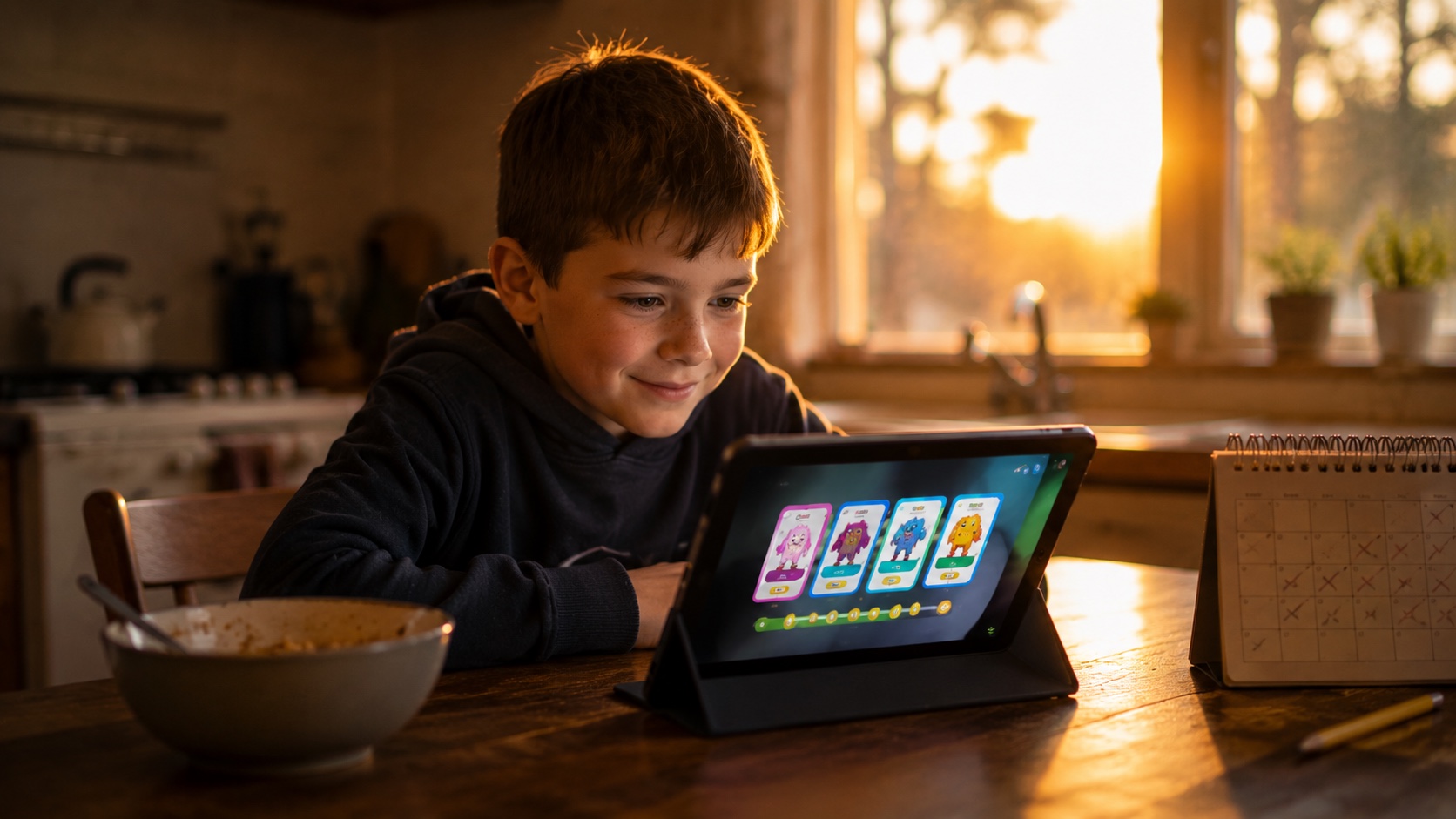
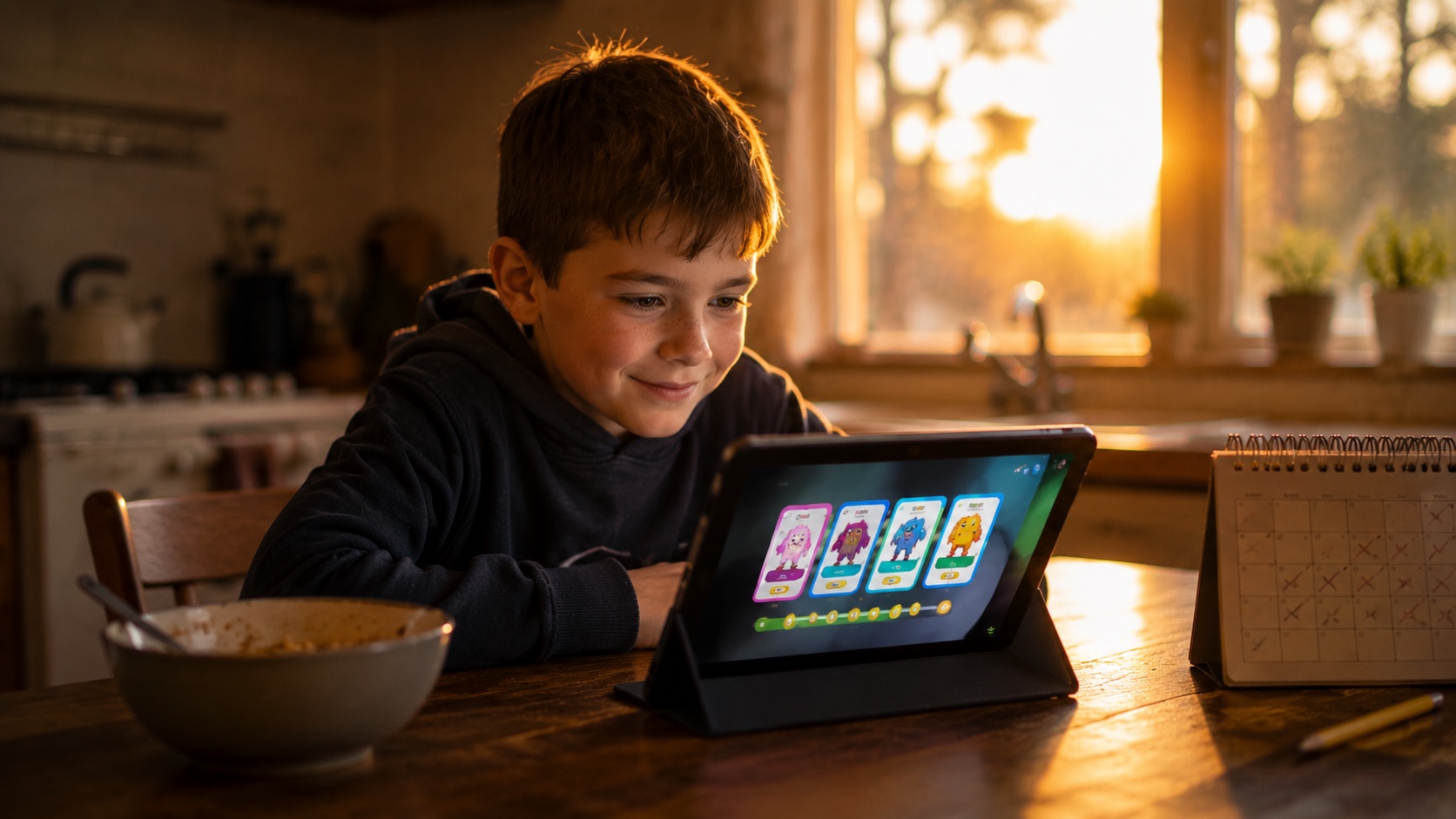
The core mechanic is a daily deck of 10 to 15 cards covering science, history, geography, math, language, and general culture. When the deck is done, it\'s done. No autoplay. The app closes the loop itself.
The reward system is built on variable reinforcement — the most powerful behavior mechanism in psychology. Beyond streaks and points, kids can unlock rare cards (Common, Rare, Epic, Legendary) based on performance. The unpredictability of when a Legendary card appears keeps the dopamine response fresh, which is exactly why this mechanic sustains habits better than simple point accumulation.
Difficulty adapts automatically based on recent performance. A child who answered 80% correctly yesterday gets slightly harder cards today. No parent intervention required.
What is BrainOshi?
BrainOshi is a daily learning app for kids aged 6 to 15. Every day, your child gets a fresh deck of 10 to 15 interactive cards across science, history, math, geography, and more. The deck ends itself — no infinite scroll, no screen-time battles. Adaptive difficulty, real gamification, parent dashboard included. Free plan available, no credit card required.
→ Try it free at brainoshi.com
What One Parent Told Me
A mother of two (ages 8 and 11) described the before-and-after: "Before, every learning app turned into a negotiation. Now with BrainOshi, the deck just ends. They close the app themselves. My 8-year-old asks if she can do her deck before dinner. I\'ve never had to remind her once this month."
That last sentence is what a working habit looks like. The behavior happens without external pressure. The cue triggers it, the routine is short enough to feel easy, and the reward is strong enough to make them want to come back.
You Don\'t Need a Perfect Routine
The most common mistake I see parents make is waiting until they have the ideal conditions to start. That moment rarely arrives on its own.
Habits don\'t start with perfect conditions. They start with one consistent action, small enough to do even on a bad day, rewarding enough to want to repeat.
The science is clear on what works. The only variable left is starting.
Try BrainOshi Free — No Credit Card Required
Give your child a 10-minute daily learning habit backed by behavioral science. Interactive decks, real gamification, adaptive difficulty, parent dashboard. Start today and see the streak counter hit day 7.
Start free at brainoshi.com →FAQ
How long does it take to build a learning habit in a child?
Research from University College London suggests habits take an average of 66 days to become automatic, though this varies. For kids aged 7 to 12, a daily learning session with immediate, satisfying rewards tends to become self-sustaining within 4 to 6 weeks. Consistency of the reward loop matters more than duration.
What is the best time of day for kids to do learning activities?
The most effective time is the one that consistently happens. Habit research strongly favors anchoring new behaviors to existing routines — after-school snack time or the transition period after arriving home are reliable anchors. The consistency of the cue matters more than the clock time.
How many minutes per day should a child spend on educational activities?
10 to 15 minutes is the evidence-backed sweet spot for children aged 6 to 12. This aligns with focused attention research and is short enough to eliminate resistance to starting. 10 minutes every day outperforms 60 minutes once a week for long-term retention.
Why do kids lose interest in learning apps so quickly?
Most learning apps optimize for engagement metrics rather than habit formation. Infinite content queues and autoplay remove any natural stopping point, creating parent-child conflict. This negative association erodes the positive emotional response needed for a habit. Apps with a built-in session endpoint and immediate completion rewards show better long-term retention.
Can gamification actually improve children\'s learning outcomes?
Yes, when applied correctly. Variable reward schedules — where rewards are unpredictable — produce stronger habit reinforcement than fixed rewards. Streaks, rare item unlocks, and performance-based badges tied to daily consistency have been shown to improve both retention rates and content recall in children aged 6 to 14.